A time worn photograph, badly reproduced --- but one with a story behind it worthy of telling here, perhaps for the first time --- in a very long time indeed.
On an oppressively hot day, August 31st of 1929, a special train pulled into the railway station in Fresno, California and deposited a cargo the likes of which, if a similar event occurred today, would be fodder for every evening news broadcast and television "entertainment magazine" show imaginable.
Unloaded from the train to be met by throngs of cheering fans, photographers and Fresno's dapper mayor, Z.S. Leymel, was a fair portion of Warner Brothers-First National & Vitaphone's most precious cargo: it's stars and directors.
Monte Blue, Edward Everett Horton, Patsy Ruth Miller, Frank Fay, Douglas Fairbanks, Jr., Dorothy Mackaill, Alice White, Noah Beery, Georges Carpentier, Myrna Loy, Edna Murphy, Frank Lloyd, Lloyd Bacon, Loretta Young, Alice Day, Grant Withers, Tully Marshall, William Boyd, Hallam Cooley, Walter Woolf, Winnie Lightner, Lee Moran, Vivian Segal, Marion Byron, Sally Eilers, Bull Montana, William Bakewell, Armida Vandrill, Jaqueline Logan, and, apparently on a day-pass from Metro, Joan Crawford --- then acting as Mrs. Douglas Fairbanks, Jr.
Also stepping off the train and gaining somewhat less attention was Warners' General Manager of Theaters, Max Shagrin and Mrs. John C. Porter, wife of the mayor of Los Angeles. As the mayor's chauffeured limousine sped towards Fresno, it was said to be passed by a private airplane holding a party of eleven, with chief passenger being Warner Bros. executive Darryl F. Zanuck, and Benjamin Warner, father of the boys who would one day own a movie studio.
This wasn't, as one might suspect, a publicity opportunity concocted to drum up interest in studio's all-star revue "The Show of Shows" which would be released in four months time. Rather, all this performing and creative talent was gathered on a blistering day in Fresno to participate in opening day (and night) festivities for a something that would get scant attention today. A new theater opening with a new movie.
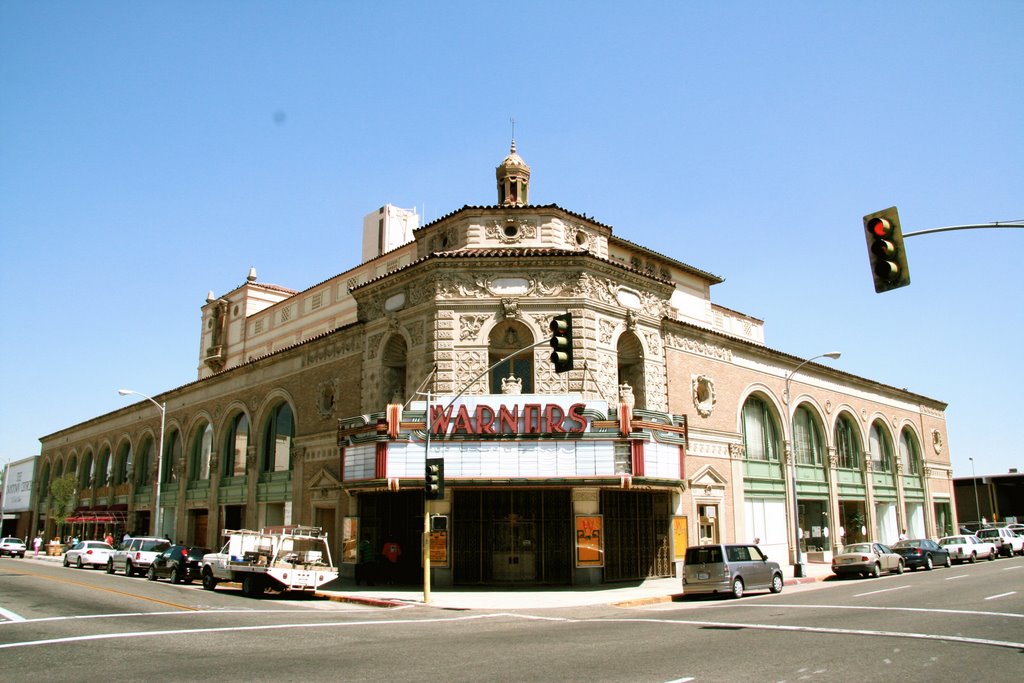
Built only a year before as part of the Pantages vaudeville house chain, the stunning theater (B. Marcus Priteca, Architect) blended Spanish, Moorish, and Italian Renaissance-Revival elements into one cohesive terra-cotta whole, with store fronts built into the flanking sides of the building that maintained the structure's design throughout.
While workmen and electricians worked throughout the day outside the theater to set up wooden blockades, bleachers, floodlights and a powerful street level loudspeaker connected to the stage microphone, the elite of the Warner Bros. studio made tracks to their accommodations at Fresno's Californian Hotel --- with some remaining at the hotel and others making personal appearances around town, including a ladies' club and a public "plunge" in Sunnyside, where a few of them joined flabbergasted citizens in the pool and "proved themselves expert swimmers."

By late afternoon, spurred on by word of mouth and decidedly spectacular newspaper ads such as the one pictured above that appeared in the morning newspaper, crowds had begun to form lines outside the theater that would eventually stretch for four blocks, creating numbers that were more than twice the capacity of the Fresno Warner Theater --- which by sunset, was bathed in floodlights and flashed with huge searchlights, setting it brilliantly ablaze against the darkening azure sky behind it.
While crowds continued to gather outside the theater, grateful for the slowly setting sun and breeze that came with it, a grand dinner for 150 in the ballroom of the Californian Hotel was winding up, that had been "marked by the attractive decoration of the ballroom and the lovely gowns of the various actresses." That summer, full body tans had been the vogue --- a fad that even spawned a film, "Tanned Legs" (RKO) --- and newspapers couldn't resist calling attention to the bronze effect (described as "white and gold skin tones") of Alice White, Edna Murphy and Mrs. Fairbanks (Joan.)
Shortly before 7:PM, Warner Bros. notables headed to the new theater, their arrival announced via a loudspeaker that did losing battle with the cheers, screams, and whistles that were thrown upwards from the crowd. By 8:30PM, with the show underway inside, lines outside continued to increase --- and by 10:PM, with hopes of getting inside gone, the crowds opted to wait for the stars to emerge --- although with less patience than previously displayed, requiring police to be called in to maintain order. Still and all, the mood seems to have been one of pure festivity and celebration --- and all for a form of entertainment that, only a year before, had barely made an impression on the public.
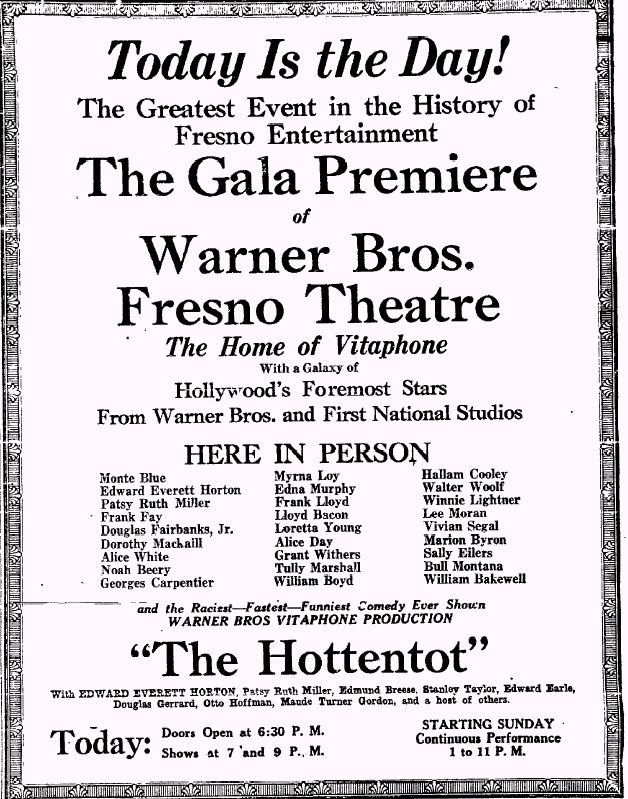
For the audience that was safely in the much coveted seats inside the theater, it was a memorable evening, "the high spots of which were Frank Fay's dexterous handling of the job of Master of Ceremonies, Monte Blue's speech, the unexpected appearance of Joan Crawford, who came on with her newly-acquired husband, Douglas Fairbanks, Jr.; the broken English of Georges Carpentier, who some people still wish had licked Dempsey, and Bull Montana in a very short but effective impersonation of himself."
"After the personal appearances of the stars came the feature picture, 'The Hottentot,' starring Edward Everett Horton, supported by Patsy Ruth Miller. This picture was made from the stage success of the same name, and is based on the predicament of a man who, never having ridden a horse before, attempts to act as jockey in a famous steeplechase."
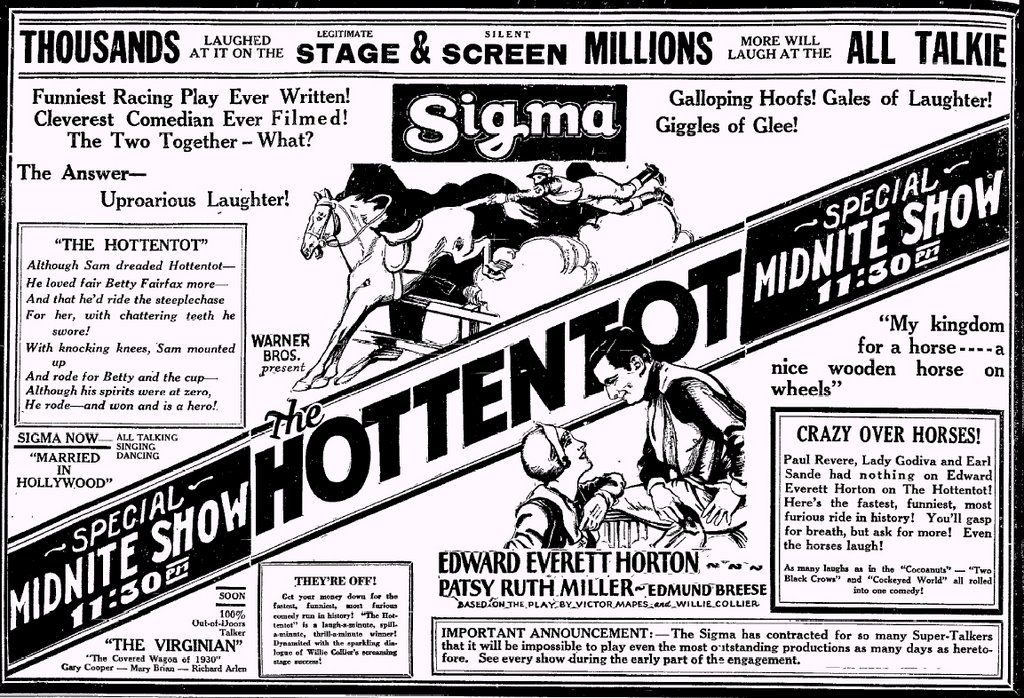
The film, "The Hottentot," directed by Roy Del Ruth, may seem at first an odd choice for so gala an event, as it wasn't a large scale film by any means, without the glitzy appeal of the Technicolor process that was starting to infiltrate a good many Warner films, and it was of fairly short length too. Yet, it achieved exactly what it was designed as: a swift-moving, light, action-comedy peppered with sharp, funny dialogue.
The New York Times: "...hilarious talking picture. The dialogue in the picture is fast and funny, and the audience at yesterday's matinee missed a good many laughs when its mirth overlapped the ensuing lines. This is an example, it is to be presumed, of how really enjoyable a picture can be by having only good, clean fun. Miss Miller is sufficient and pretty as the heroine."
Variety: "... the dialogue is abundantly hoked, with some male members of the cast exaggerating this by inferior performance, (but) the theme is touched by the whip at the start."
Mistaking Sam Harrington (Horton) who greatly fears horses, for a famous steeplechase rider, Peggy Fairfax (Miller) enthusiastically prevails upon him to ride the high-spirited horse, Hottentot. Director Roy Del Ruth added a clever touch of the sort later to be coined as "screwball" to his presentation of Miller and her horse riding and racing obsessed family, as the New York Times review by Mordaunt Hall indicates: "Her whole family is... horsey. The sheet music on the piano is composed of songs about equines, the statuary in the house are all models of horses, and the family plays a horse-racing table game while dressed in riding clothes."

Some seventy-seven years after that forgotten day and night in Fresno, time has been selective if not a bit cruel as to what remains today. Newspaper accounts, photographs --- perhaps a newsreel (surely Warners would have seen to that!), but little more. Prints and negatives for "The Hottentot" aren't known to exist, and the surviving audio from a European release version eliminates all the dialogue that prompted so many gales of laughter in theaters across the country. Although it can be compared to opening a rare old beautifully bound volume and finding no words imprinted inside, some faint idea --- or feel, of the film may be gained from the following audio selections.
Here, from an early portion of the film, an incredulous Edward Everett Horton is led into Patsy Ruth Miller's "horsey" home. Terrified of equines, Horton notes with mounting discomfort a telephone receiver in the shape of a horse's head, horse paintings and statuary everywhere and a piano laden with horse-themed tunes: "Horses," "The Old Gray Mare," "Barney Google," etc.
From the closing moments of the film, following Horton's unintended steeplechase victory --- Horton's confession to Miller of the fluke and his loathing for the beasts, which segues into reconciliation and his romantic victory in Miller's arms. The jaunty melody that closes the film can also be heard in a fox-hunting sequence ("Bring on the dogs and horses," shouts the stage manager) in another Warners production of 1929, "On With the Show."
On the bright side, the theater that began life as a Pantages and became the Warners a year later, still survives --- miraculously intact, largely unaltered inside and out, and seemingly lovingly maintained by the present owners. Best of all, it's still very much alive --- used regularly for select film, stage and musical performances --- and spared the saddest of all fates for a vintage theater, that of being shuttered and left to slowly decay before being torn apart by heavy machines and sledgehammers.
I've always felt that if not buildings, then at least places certainly, retain a memory or an imprint of an important event that had been laden with human emotion. If so, the theater that proudly stands today --- seeming perhaps a bit dismayed at the changes that surround it --- has at least one fond memory, often replayed in ghostly silence, embedded deep inside itself. Can a building smile? I believe this one can, and does.

###