Showing posts with label Ann Pennington. Show all posts

02 January 2007

Between the Acts

A bit of fun while the next post is in preparation.

As noted in an earlier post ("Divertimento" 6 December 2006), actress and dancer Ann Pennington was a featured dancer at the 1939 New York World's Fair, appearing regularly as part of "George Jessel's Old New York" exhibition at the Fair's amusement area.

Here, looking much as she did ten years earlier when performing similar dance routines in "Gold Diggers of Broadway" and "Happy Days," is Ann Pennington --- excerpted from Kodachrome home movie footage taken at the Fair, with a bit of 1930 music attached for effect and added illusion.


###

13 December 2006

Divertimento

The young lady depicted to your left in poster artwork for the Warner Bros. All-Technicolor 1929 musical "The Gold Diggers of Broadway" is Ann Pennington. While largely underused in what would be her most important, popular and successful screen appearance, her trademark high-kicks and knack for the "shimmy" dance movement electrified audiences attending the film, just as they did well before 1929 and long after.

Although I've not seen enough of her small body of film work to pass absolute or even fair judgement of her versatility as a dancer, (her two key dance scenes in "Gold Diggers" have yet to resurface) it is however interesting to note that her dancing in "Tanned Legs," "Happy Days" and (presumably) "Gold Diggers" is all much the same --- although what she does, and how she does it is undeniably unique. Her screen dance moments are possessed of such apparent ease, abandon and seemingly tremendous enjoyment of the moment that to watch her can't help but be a memorable experience because she rings so utterly true. Whatever the role or character, it all falls away when she's called upon to dance, and what's left is pure pleasure.

As noted, although I've only seen enough of Pennington to amount to a handful of minutes, I was surprised not long ago by just how identifiable her style of dance was. While viewing hours of silent Kodachrome film footage taken at the 1939 New York World's Fair, a fleeting moment of film taken an outdoor Fair attraction titled "George Jessel's Old New York" had an oddly familiar look to it. Seen from a distance, on the silent footage that moved far too quickly, onto a small stage designed to look like an early 1900's boxing ring, bounded a short, plump raven-haired woman I felt certain was Ann Pennington, and later discovered certainly was. The dancer duplicates the same dance steps she had performed in films only ten years earlier but which, by 1939 was so distant that it was accepted as a Turn of the Century style performance by the assembled crowd of perhaps forty or fifty spectators. Eerie.


Ann Pennington's absence from release prints of the 1929 Warner Bros. revue "The Show of Shows" is puzzling in of itself, but made more so by the film's use of a tune called "Believe Me" in the finale that would turn up soon thereafter in a Technicolor short subject that starred the actress, titled "Hello Baby." Unlike every other tune employed in the massive closing sequence, "Believe Me" isn't to be found anywhere else in the film, which suggests that earlier presentation of the melody in the body of the film was cut before release in an effort to trim off minutes of an already long motion picture. A commercially released 78rpm recording by Irene Bordoni (a featured performer in the Warner revue) of the tune further hints at the fact that the deleted sequence may have featured the French performer as well as Pennington, and a curious production photograph of Myrna Loy and Grant Withers in historical costume of vixen and gladiator also (possibly!) suggests that "Believe Me" may have served as the melodic framework for a tableaux of some sort.

In general release at the same time as "Show of Shows," the two-reel All Technicolor short "Hello Baby" (which shares fairly equal billing with the Rin-Tin-Tin feature depicted left) is a happy example of a lost film that emerged from the shadows quite unexpectedly, and in it's original well-preserved Technicolor hues too --- an unlikely event in of itself. Without having seen it, it's difficult to ascertain whether Pennington's performance of "Believe Me" could possibly have been lifted bodily from "The Show of Shows" after having been snipped, but the surviving disc audio hints at this, as the arrangement and orchestration of the tune is virtually identical to the version heard in the revue film. This audio extract features the two-reeler's opening title music --- which gives way to the sound of a back-firing jalopy of the sort in vogue among collegians at the time (often with all manner of motto and snappy expressions painted on the car body) and then the puzzling tune in question, "Believe Me," vocalized by Miss Pennington and then reprised by the chorus.

"Believe Me" (1929) Ann Pennington


Co-starring with Ann Pennington in "Gold Diggers of Broadway" was Winnie Lightner who effectively walked off with both the film and the lion's share of critical acclaim while instantaneously endearing herself to audiences as well. For many of those who would flock to see "Gold Diggers" either on it's initial release or at one of the film's many return engagement "by popular demand" bookings (that continued into the early 1930's) Lightner wasn't precisely a new face and certainly not a new discovery --- but she did, at last, seem to find the perfect arena for her persona and talents.

First hitting the "big time" in two Broadway editions of Shubert's "Gay Paree" musical revue that ran for a combined total of 373 performances between August of 1926 and April of 1927 on Broadway alone before touring, Lightner was enough of a whirlwind presence to gain special mention in nearly every review of the production which, as a whole, was met with mixed reception as indicated in the December 1925 review below --- just the sort of review that then, as now, would have guaranteed a box office rush!

It wasn't more than a few years before time and technology combined to result in Lightner (who was aptly billed as "The Song A Minute Girl" or "The Joy Girl of Song") being called before the Vitaphone film and recording apparatus, and her one-reel short subject(s) were so exceptionally well received that they continued to be booked well after their initial 1928 release.

Aside from her memorable appearances in "Show of Shows," in which she introduced the immortal brutal parody of "Singin' in the Rain" titled "Singing in the Bathtub," "Life of the Party" and the missing believed lost feature "She Couldn't Say No," Lightner was at her unrestrained, rambunctious, raucous and endearing best in "Gold Diggers" and "Hold Everything." The latter film, a 1930 All-Technicolor musical comedy visualization of the Broadway success that has, unhappily, completely vanished --- leaving only it's sound discs behind to intrigue, entertain and feebly hint at what once was a hugely popular film success that, judging by the surviving audio, would make another all-Technicolor 1930 stage-to-screen musical, Paramount's "Follow Thru," seem a very weak sister by comparison indeed.

Two examples of Winnie Lightner, from "Gold Diggers of Broadway" and "Hold Everything."

In the first extract, Lightner positively scandalizes poor blustering Albert Gran with her rendition of "Keeping the Wolf From the Door" during an apartment party sequence in "Gold Diggers of Broadway," wherein Gran sees his fate being sealed with each "woof!" Winnie emits in his direction.

"Keeping the Wolf From the Door" (1929)


From "Hold Everything," and in keeping with the production's unlikely (but successful) setting within the world of boxing championships, Winnie Lightner is joined by a singing and dancing chorus (all clad in stylized satin boxing togs of various hues) in "Take It On the Chin."

"Take It on the Chin" (1930)

The legendary "long count" boxing match between Gene Tunney and Jack Dempsey held in September of 1927 was very much a certifiable "media event" long before the term would be coined, and the event was so rapidly absorbed into popular culture via print and electronic media, that details of the event would still be vibrant and immediately identifiable to listeners of a clever 1927 recording by pianist/comedian Clarence Senna. Recorded in the last days of December of 1927, it's easy to imagine the record being played in many a home as 1928 dawned. It's one of those rare topical recordings that has the power to put the modern day listener right there in the moment of the day. (Below Left: Gene Tunney - Below Right: Jack Dempsey.)

If you're reading this blog, chances are you need no introduction to either the film "The Broadway Melody" (Metro-1929) or one of it's stars, Charles King. Invariably the recipient of harsh criticism for a style of acting and vocalization we can't easily understand or appreciate today, I believe that he (and many like him) can best be appreciated if you alter your perception a bit.

Rather than consider (as many books tend to) "The Broadway Melody" as the spark that created a brief film career that would vanish by the mid-1930's, a more truthful appraisal would include the understanding that the landmark film musical simply served to crown a very long and very successful career. He was a man in the right place, at the right time and with the right and credentials to appear in "Broadway Melody", but if the film never happened, he would have still possessed the sort of career that most performers born directly into cinema could only hope to.

Partnered with singer and composer Elizabeth Brice in the 1914-1915 Irving Berlin "syncopated musical" "Watch Your Step," (New Amsterdam Theater, New York - 175 performances) which starred popular dance icons Vernon & Irene Castle, the show served as the vehicle that put Brice and King into the spotlight, resulting in featured appearances in the touring company of "Watch Your Step" throughout 1916, as well as individual vaudeville bookings for the pair and a Columbia recording contract that same year as well.

While clearly rooted to 1916, it's as enjoyable as it is curious to hear Charles King in the recording that follows, because owing to our presumed familiarity with the 1929 film it becomes immediately clear that his performance style was cemented by the date of this recording --- meaning that he was, quite simply, just himself in the early talkie; a proven talent on stage and screen (he appeared in the aborted 1928 Marion Davies production "The Five O' Clock Girl"), utilizing a proven formula at the peak of his career --- rather than beginning one as some might suppose.

"I've Gotta Go Back to Texas" (1916)

After "The Broadway Melody" and "Chasing Rainbows," in which he was again paired with Bessie Love, Charles King gradually fades away from mention in the press --- a stage appearance and club date here and there throughout the 1930's --- but there's no indication he remained anything less than a content, healthy, popular and productive fellow pursuing and achieving a well-deserved "normal" domestic life after nearly three decades of toil on the stage, before the recording microphone, in active military service during the Great War, and ultimately on the talking picture screen.

King emerges again however, at the height of World War II, when scattered reports of his death began to appear in early January of 1944. Aboard ship en route to Britain to join a troop of USO entertainers, Charles King contracted pneumonia and died in London on January 11th, aged 57 (in truth.) King was buried in Brookwood National Cemetery, in Surrey, UK, with full military honors, yet a vast distance away from the New York street his voice so effectively sang the glories of in 1929.

Here, also from "The Broadway Melody," a Charles King rendition of quite a different tune, the solemn and wistful "Love Boat," performed in the film as a tableaux --- a nearly forgotten form of artistic stage presentation that doubtless baffles curious viewers of the film today, prompting usage of descriptive terms like "static."

"Love Boat" (1929) Charles King


Not many months transpired between the Broadway closing of Cole Porter's musical "Paris" and the November 1929 premiere of the part-Technicolor Warner Bros. screen version, no prints of which are known to have survived. Enough written and aural material exists to warrant a simple reconstruction of the film in these pages, and you can expect to find one here early in the coming year. For now, and for no reason other than that I think you might enjoy it, here are two renditions of a song from the Broadway production that was reworked for the film (four songs were cut and replaced with others for the screen version including, incredibly, "Let's Do It - Let's Fall In Love") titled "The Land of Going To Be."

Recorded for Victor in March of 1928, the music is provided by Irving Aaronson and his Commanders and the vocal by one Jack Armstrong, with some choral voices for the closing reprise.


"The Land of Going To Be" (1928)


From a set of surviving Vitaphone discs for the export version of the film, the same melody performed by Jack Buchanan and Irene Bordoni. Buchanan begins the melody on a piano in his hotel suite, is heard by Bordoni from an adjoining suite of rooms --- she then picks up the vocal while sauntering in to join the phantom musician. Caught between the striking designs of the piano and Bordoni's zebra pelt coat, Mr. Buchanan's expression is to be understood.

"The Land of Going to Be" (1929) Vitaphone Disc


Rounding out this double-sized issue of "Vitaphone Varieties," a few brief items of passing interest.

Promotion for Universal's 1930 musical revue "The King of Jazz" naturally extended onto the radio airwaves, and while nothing has survived that features Paul Whiteman's Orchestra, a radio appearance by three of his vocalists, The Rhythm Boys (Bing Crosby, Al Rinker and Harry Barris) does exist, and is excerpted here. Originally heard on K-FOX in May of 1930.


"The Rhythm Boys" (1930) Radio Transcription


Vaudevillian Willie Howard, who's performing career was born nearly along with 20th century vaudeville itself, and who achieved fame as part of "The Howard Brothers" (Eugene and Willie, pictured left in 1921) was what is best described as a "Jewish dialect comedian," and a hugely entertaining one at that. His circa-1925 recording of "When Nathan Was Married to Rose of Washington Square" is a sterling example of his work. No nervous wringing of hands is called for here, as his humor is gentle and certainly rings true to this author's ears --- which can still faintly recall hearing similar voices, humor, malapropisms and accents from his early childhood days in the heart of blue-collar Irish, Italian, German and Jewish Brooklyn. First or second generation New York immigrant voices, --- which, once passing on, weren't to be replaced by others. Rather, just simply lost to time and memory and sometimes, as in this recording, preserved forever. Dearly, and sorely missed voices.

"When Nathan Was Married to Rose of Washington Square" (1925)

Lastly, and you may consider this "Exit Music" for this edition, an infinately catchy tune from Metro's largely underappreciated or misunderstood (or both) anti-hero musical of 1929, "Lord Byron of Broadway." Performed here in a British recording by the spot-on Harry Hudson Band, "The Woman in the Shoe" is bound to linger long after you've heard it, and is actually a far better rendition than would be recorded here in the States by the usually excellent Nathaniel Shilkret, who missed the mark somehow with this one.


"The Woman in the Shoe" (1930)


(Photographs of Ann Pennington (1925), Eugene and Willie Howard (1921), Gene Tunney (1927) and Jack Dempsey (1927) courtesy of the Chicago Daily News Collection of the Chicago Historical Society.

SDN-066937, SDN-066851, DN-0079720, & DN-0073416.)

###

07 December 2006

Snake Hips


"The terraced minstrel show set with its lustrous expanse of gold and silver drapes, its fourteen huge jeweled sunbursts, its mammoth spreading fans in red, green and gold, all in a blaze of perfect lighting, is, perhaps, the most notable of the sets and when it is populated by 150 screen personalities all in brilliant and gorgeous costumes, the picture is beyond description."

So described a 1930 newspaper advance publicity placement for Fox's "Happy Days." Once I got past the beautifully descriptive prose, it occurred to me that I hadn't previously thought of the film as originally containing color sequences, but the thought was hugely appealing --- especially when combined with envisioning how the film might have looked upon it's premiere at New York City's Roxy Theater, where it was screened in the 70mm Fox Grandeur wide-screen process as well. Were this true, it's well neigh impossible to imagine the sensory overload that would have greeted 1930 audiences attending that most glorious of a cinema palaces and one which would be demolished after a mere thirty years of life: Color, wide-screen and Fox's unparalleled (in my opinion) Movietone sound process bathing each of the 5,920 upholstered seats in sight, sound and color. Overly dramatic I know, but not far from an early sound film buff's notion of heaven.

With the Roxy Theater long gone (it's entrance now marked by a T.G.I. Friday's) and "Happy Days" barely surviving in openly traded and sold 98th generation dupes --- a mottled, tattered, bleached, garbled and truncated shadow of its former self --- it's no small wonder the film is all but sneered at when written about, and surprisingly, it's even scoffed at by the only fan base it could possibly claim at this late date, that being the legions of Will Rogers' admirers. The film's parent studio apparently didn't think enough of it (or at all) to include it in two DVD boxed sets of Rogers' sound films and that's probably just as well considering the likelihood that the Rogers scenes would simply be extracted from the body of the film and included as an "extra" with little or no explanation.

But, I stray. Did "Happy Days" originally contain color sequences? The introductory paragraph certainly goes out of it's way to suggest so. Then too, not all --- but some period "reviews" for the film (of the variety written by theater owners who pre-screened prints before booking) seem to solidify the press campaign's claim by saying, merely, "Some of the scenes are in Technicolor." Well, perhaps
not Technicolor --- but another color process? So, until anyone can offer up real proof pointing one way or the other, we can't be certain.

One of the film's most striking musical and tuneful sequences, in pastel hues or not, is "Snake Hips," which was promoted in newspapers by asking: "Do snakes have hips or not?" and then inviting them to see for themselves in a verbal elbow-nudge fashion.

Starkly designed with two gigantic curled cobras on either side of the set --- with bodies and heads rising and curling upwards to meet in the center forming an exotic proscenium arch, the beauty of the number's design and the shimmering metallic costumes are all but impossible to appreciate or even clearly ascertain in circulating dupes, which reduces individual dancers into undulating blobs without clear face or figure. The film's soundtrack has suffered right along with the visual elements too, and gone are the original Movietone crystalline highs and deep, warm and rich bass notes. Further assault comes in the form of no less than two cuts within the sequence, one of which deletes Sharon Lynn's entire vocalization of the song's chorus. With that warning in mind, and to oblige a reader request, here then is an audio reference for "Snake Hips" in the form it can be found today. No amount of mucking about with audio enhancement can undo decades of damage, but weak as this is it's actually an improvement upon the original source material!


"Snake Hips" (1930)


Scattered and wildly incomplete though surviving examples of early radio are, every once in a great while something comes along that almost effortlessly sweeps away volumes of dry written documentation simply by allowing us the ability to hear for ourselves, and experience something that no amount of prose --- however skillful --- can hope to emulate.


One Tuesday evening in May of 1928, an engineer working at the Thomas Edison Laboratory & Phonograph Works in New Jersey (pictured left) was busily testing a new recording process that would allow for long-playing discs. Seeking a continuous source of recordable material as opposed to recordings that would have to be changed every few minutes, the engineer decided to utilize a radio set in his workroom and at 8PM, he tuned into radio station WEAF, (which was carrying programming from NBC) and began his test recording, which lasted 18 minutes.

When finished, he filed the disc away with some jotted notes on the recording process and results, without knowing that some seventy-five years later his experiment would be rediscovered and that what he captured --- quite without thought as to posterity, would be the earliest known over-the-air recording of a live broadcast and, as it turns out, a broadcast consisting of popular music.

An entry in the NBC "Eveready Hour," a sponsored anthology/variety program that offered a diverse selection of dramatic, musical and comedy offerings, the captured fragment of entertainment and technological history is listed in the radio guide from that date only in the briefest of forms, without detail as to scheduled artist or theme. From the surviving broadcast itself, we learn that the setting is that of a night-club, and that the featured singer is one Martha Copeland, about whom I could discover nothing further. In researching various radio listings for the Eveready Hour from that same week and month, however, I think I can tentatively conclude that the accompanying vocal group that backs Copeland is The Hall Johnson Choir (a famous choral group of the day that was featured in a variety of entertainment mediums, including --- most notably, the 1929 Bessie Smith two-reeler "St. Louis Blues") and that it's probable that the orchestra was under the direction of Nathaniel Shilkret.

In the following two brief extracts of somewhat reduced quality from the full recording, Miss Copeland puts over a wonderful rendition of the pop standard "I Ain't Got Nobody" (including a disorienting shout of "everybody rock!" during the song) and then, a stirring vocalization of "The St. Louis Blues," performed here in an arrangement that foretells the ultimate Bessie Smith version that would arrive the following year, replete with similar haunting vocal backing by The Hall Johnson Choir.


"The Eveready Hour" (1928) Excerpt 1

"The Eveready Hour" (1928) Excerpt 2


Interested readers should make haste for the home page of the public-radio broadcast that first premiered this recording in 2003, "Thomas Edison's Attic," which is maintained by Edison recording historian supreme, Jerry Fabris. Displaying an unparalleled passion, knowledge and respect for Edison recording artists and their product, Mr. Fabris is as unique a gem as could be hoped for in this incredibly overlooked and underestimated niche of American popular music history. The material he broadcasts, originating directly from the original medium of cylinder or disc, is of astounding quality and variety, and guaranteed to cause any listener to rethink any existing notions they may have about early sound recording. With that in mind, please visit: http://wfmu.org/playlists/TE

Somehow or other, I've not yet managed to see D.W. Griffith's "Lady of the Pavements," a 1929 United Artists release that arrived on screens with a synchronized music and sound effects score and at least one dialogue sequence. Happily, the film survives today (although without it's sound elements) and I've heard that at least in some screenings, the film's lilting theme song ("Where Is the Song of Songs For Me?") the tune is given its due either by interpolation into the live piano accompaniment or by the playing of the film's star, Lupe Velez's 78rpm recording released in conjunction with the film's premiere. Either way, it's an admirable effort to try to correct damage wrought by time and neglect and one I applaud. In tribute to both the film and those who still present it, here's two renditions of the theme song. The first by Lupe Velez --- touching, skilled and exotic, and the second by vocalist Franklyn Baur, clear, resonant and timeless.

"Where Is the Song of Songs for Me?" (1929) Velez

"Where Is the Song of Songs for Me?" (1929) Baur


In a much lighter vein, I introduce vocalist Sid Garry, who recorded for a mind boggling array of "dime store" record labels throughout the 1920's --- and possibly prior and beyond, as concise information on his career hasn't been easy to pin down. What I do know is that no matter the record label he's encountered on --- Banner, Cameo, Domino, Perfect, Regal, Romeo, etc. to name but a few --- or no matter what name he used ("Al Foster" was a common alias), his voice and style is as unique and immediately identifiable as a thumb print... or blood stain. Adding a whole new dimension to the old descriptive term "he sings with a tear in his voice," Sid Garry has been delighting me for years by almost always seeming to be on the verge of weeping as he sings, and by a style of pronunciation and inflection that's his and his alone. I'd love to know more of Mr. Garry (or Mr. Foster,) so if any reader should have additional information, I urge you to share it!.

For the uninitiated, here's two familiar standards of the late 1920's as I suspect you've never heard them performed before. Typically, Mr. Garry either selected or was wisely called upon to vocalize tunes of an emotional or sentimental nature, and these two melodies, "Mean To Me" and "Tip Toe thru the Tulips" are prime Sid Garry. (Pictured right, Mr. Garry/Foster, himself.)

"Mean to Me" (1929)

"Tip Toe thru the Tulips" (1929)


Closing out this post, two additional requests that I'm pleased to be able to meet. In relation to my earlier posts regarding The Duncan Sisters, I was reminded that I overlooked one of their finest recordings, "Dawning" of 1927 --- and I'm glad this oversight was mentioned. A simple melody, the theme of which dwells upon dawn, early morning, mother's arms, yawning babies, and the rooster's call to awaken, it's comfort food of the musical sort that effortlessly stirs memories of childhood and home --- our first home --- that dwells within all of us, somewhere. As described in the Victor record ad at the left, the Duncan Sisters "each has a piano to accompany her --- that is, there are two pianos, while Vivian plays the uke. Against this background, they sing two of the charmingest ditties." The flip side tune, "Baby Feet Go Pitter Patter" is just a wee bit too charming, even for me. "Dawning," however, is magnificent and just charming enough.

"Dawning" (1927)

Lastly, for a flash finish, a high spirited medley of selections from the 1930 United Artists film "Puttin' on the Ritz," consisting of "With You," "There's Danger In Your Eyes Cherie" and of course the seemingly indestructible title tune. Of passing interest, in the ad below, note that the credit listings for a coming attraction, "Second Wife," has the odd billing "The New Lila Lee" for the extraordinarily prolific and skilled actress. This "new" tag, although of questionable taste, refers to the fact that the actress had underwent what amounts to a nervous breakdown (highly publicized too) following a grueling stretch of work in film upon film, in support of the likes of Texas Guinan in 1928, Sophie Tucker in 1929 and Lon Chaney in 1930 --- just to name a few. This "new" billing is an idea before its time, although if in use today it would likely have to read: "The Newest New, Really New, New as Today, _________." Ah, just as well it hasn't been borrowed, I suppose!


###

13 November 2006

Melody Native

When the early talkies weren't busily exploring the backstage area of theaters and night clubs --- which wasn't often, they displayed a remarkable diversity of settings that belies the popular and largely incorrect notion that they were all hopelessly static, claustrophobic productions. If anything, it's the films that would arrive in 1931 and 1932 that seem to me to always be set primarily in offices and apartments, --- or at least the vast majority of them do.

Audiences between 1929 and 1930 who desired something other than views of dancing legs, dressing rooms and city streets enjoyed a wealth of options. Those seeking far flung exotic locales could see films set in jungles, tropic isles, the Far East, atop the ocean and underneath it, and amidst polar glaciers. Equally exotic but no less picturesque were films entirely or partially set in prisons, airplanes, zeppelins, submarines, ships of the sail and steam eras, rail and subway trains, coal mines, the deep woods, snowy mountain ranges and just about every European city you can think of, ancient and modern.

The one setting that most easily lent itself to melody (although no setting or locale was beyond the ingenuity of film theme song composers) was the tropics. Irresistible to composers and lyricists, even what is thought to be the first modern era stage musical, "Florodora" (1900-1902) had a mythic tropical setting that allowed for at least two songs which celebrated that fact --- and countless tropical themed melodies would follow in the coming years, most rather undistinguished and sounding suspiciously much alike, but vastly popular nonetheless.

"The Pagan," an MGM feature released in April of 1929, hit the mark with escapist minded audiences and devout fans of its star, Ramon Novarro, alike. Although a silent film with a synchronized music, vocal and sound effects score, "The Pagan" had enough drawing power to succeed at a time when theaters were swelling with all-talkie product. Visually stunning, and containing what many justly believe to be Novarro's signature performance and perhaps even role of a lifetime, success of "The Pagan" was also due in no small way to the film's theme song, which swept the country and globe before, during and after the film's release. Despite the widespread popularity, it's always interesting to find one somewhat slightly dissenting voice, as it was with one unnamed reviewer in a July of 1929 newspaper:

"Novarro, who is said to be studying for the opera, sings the theme song --- and you are never in doubt deciding it to be the theme song. It is sung again and again, at opportune times and some not so opportune. This song is the only vocalization...."

While not the "only vocalization" in the film, "The Pagan Love Song" may arguably seem that it is. That aside, its first presentation in the film is incredibly memorable, with Novarro first hearing the melody as a siren song --- from a distance, wafting across water, seashore and greenery. Intrigued, he follows it --- slowly, then rushing forward through the underbrush, while "answering" it with his own vocalization of the tune until he reaches the source, thereby kicking off the film's plot-line. Far better seen and heard than described, the effect is dramatically lessened by an error in circulating prints that ruins the once careful synchronization, rendering the sequence more than a bit confusing and unintentionally clumsy. A few moments of a well placed someones time is all that's needed to fix the problem, but --- ah well, so it goes.


One of the purest and most faithful to the source period interpretations of the tune can be heard here by vocalist Annette Hanshaw. Epic in its simplicity.

"The Pagan Love Song" (1929)

1929 would also find Joan Crawford removed from a dance floor and placed in a jungle in "Untamed," but unlike "The Pagan," her character (given the chimp-ish name "Bingo" here) lost no time in hitching a ride back to civilization and, well --- dance floors. The film spawned two popular melodies, "That Wonderful Something" (which can be heard in numerous other 1929 and 1930 Metro films as background music) and the far more memorable, in my opinion, "Chant of the Jungle."


Here, two fine 1929 versions of "Chant of the Jungle" recorded just weeks apart. The first a strident, somewhat sensual rendition by Paul Specht and His Orchestra for the Columbia label, and the second a more playful, high spirited interpretation by Nat Shikret and the Victor Orchestra.

"Chant of the Jungle" (1929) Paul Specht & His Orchestra


"Chant of the Jungle" (1929) Nat Shilkret & His Orchestra


The only palm tree to be seen in Warner Bros. "Is Everybody Happy?" (1929) was one serving as a backdrop for a wonderfully tawdry song and dance number by Ann Pennington, the chirpy and risque tune "Samoa," which can be heard (although not seen --- the film is lost) in an early sequence where fresh from Budapest to New York City immigrant and saxophonist Ted Lewis happens upon his leggy girlfriend from the old country after spotting a poster outside a "follies" theater.


"Once they sail into the bay, then they never sail away,
from old Samoa --- Hello, Aloha!

It's the port of missing men, 'cause they won't come home again,
from old Samoa!

They say the native girls wear dresses there with leaves that are grown,
I've never seen a sailor yet who'll leave them alone ---

Once I heard a captain crack, as they danced around his shack,
'I want some more of some more of Samoa!'"


Simply because we have the rare luxury of being able to do so, here's the "Samoa" sequence from both the domestic release version of the film, and the foreign export version. The latter version gives fair indication of how these overseas release versions were prepared, with music and song being brought up front and center and dialogue being deleted altogether or bridged over with a newly prepared musical score. (The domestic release segment contains what's probably the most intentionally amusing dialogue exchange in the whole film. Listen for it!)

"Samoa" (1929) Domestic Release Version


"Samoa" (1929) Foreign Release Version


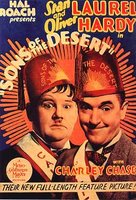
Lastly, although firmly out of the early talkie era, and for no reason other than I think you may enjoy it, a few moments of the Hawaiian themed melody, "Honolulu Baby," from the 1933 Metro-Roach film "Sons of the Desert," which --- for the uninitiated --- starred Stan Laurel and Oliver Hardy.


Not a soundtrack excerpt nor a commercial 78rpm recording (it was never recorded for that purpose, inexplicably) the following audio is that of a scoring session disc recorded prior to actual filming and then played back whilst the cameras rolled. For those familiar with the film, it's always a novelty to hear the melody without a dialogue overlay and other ambient effects. Roach Studio composer/musician Marvin Hatley supplies the tune, and Ty Parvis the vocal.


"Honolulu Baby" (1934)

Aloha!

###

29 October 2006

In the Land of Jazz


If there's such a thing as a Land of Jazz, then I imagine it's one of the few bright corners in the Land of Lost Films, which is where the motion picture to our right currently resides, holding nightly court with thousands of other movies that meekly claim this unhappy territory as their Country of Residence.

Victims of neglect, fire, mishandling, self-destruction, greed and folly, most lost films leave traces of themselves behind --- clues both plain and cryptic that while seldom leading to their discovery and rescue, at the very least serve to provide some idea of what they were like.

Although reading about a film we can no longer see can often be fascinating, doing so is ultimately frustrating and unsatisfying --- like someone describing a delicious meal in great detail that you could have partaken in had you arrived only a few hours earlier. But, we've no choice except to work with what we have --- and sometimes, we have more than just printed text and visual mediums --- much more, in fact.

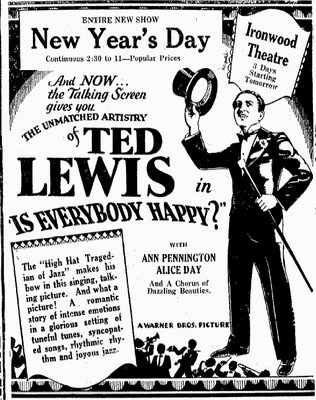
In the case of early talking films, the Warner Brothers Vitaphone product in particular, although the picture (film) element may seem to have ceased to exist in either private or public hands, oftentimes what's left behind is the film's soundtrack --- which was recorded on discs that played in synchronization with the film. Such a film was "Is Everybody Happy?" a serio-comic musical released by Warner Brothers to theaters in late October of 1929, with bandleader, musician and recording artist Ted Lewis as it's star, and who's signature phrase prompted the film's title --- which must have looked rather jarring on theater marquees to a public as yet unsure of what to make of the odd circumstances occurring on Wall Street in the last week of that month.
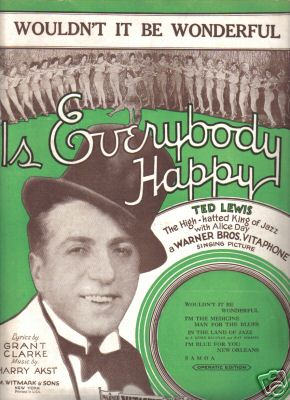
Today, we have so much of the various elements of "Is Everybody Happy?" that at times the missing visual element, the film itself, seems almost besides the point. Almost. We've sheet music, printed contemporary reviews, a complete transcript of the film's dialogue script, 78rpm commercial recordings of tunes from the film, photographic stills, movie posters, countless newspaper ads and printed publicity items including colorful advertising heralds and posters.

Lastly, but not least, we have not one but two complete soundtracks for the film that were recorded on the aforementioned Vitaphone disc system. One is the soundtrack that would have been heard along with the film in any English speaking territory in the world, and the other was especially recorded for a slightly abbreviated version of the film that was prepared for release in countries where the English language wasn't widely understood or spoken. For this export version, most of the film's dialogue was removed and replaced with explanatory title-cards written in the appropriate foreign language and the resulting product was largely a silent film with a pre-recorded musical and sound effects score. Left intact, however --- and this was the case with virtually all musical films doctored for international export at the time --- was the music and song sequences as originally performed in the film, for these presumably needed no translation, although what the patrons of a Bolivian cinema made of flashy scenes of chorus girls prancing about in New York night clubs is something lost to time and memory.
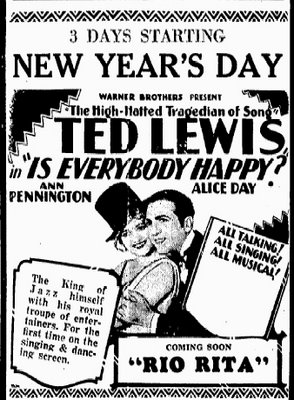

The plot of "Is Everybody Happy?" isn't far removed from that of "The Jazz Singer," in that it's the old, old story of Tradition vs. Modern Society, Age vs. Youth --- and as always, the new wins out over the old. Here, Ted (Lewis) and his family emigrate to New York City from Budapest, where Ted's aged father was a renowned violinist. Ted happens upon his old girlfriend from Budapest, Lena (Ann Pennington) who has successfully shaken off both Europe and her accent as a shimmy dancer in a vaudeville house. Ted is smitten with jazz and displays brilliant talent on a borrowed clarinet, but lacks his own instrument. Without giving much thought to the consequences, Ted sells his father's prized violin (given to him personally by the Emperor Franz Joseph) and before long is a smash success. His father, crushed and heartbroken, leaves his home, wife and son to wander off to points unknown.

As could be expected, Ted's fantastic success (he has his own night club by now) means nothing without his father's love --- and to make matters worse, his own once hot relationship with Lena has now become a noose about his neck, for he has eyes only for a lovely blonde chorine is his new club, Gail (Alice Day.) Just when things look their blackest for Ted, at Christmas of course, Lena cuts Ted loose, his Father arrives on the scene (via the nightclub where he first confides in Lena who urges a reconciliation), and everyone gathers for a bountiful dinner --- Mom, Dad, Ted, Gail and even Lena --- as Ted serenades his extended family with the film's theme song, "Wouldn't It Be Wonderful."

Audio Addendum:

For this entry, I'm offering four representative audio excerpts from both the domestic and international release versions of the surviving Vitaphone disc soundtrack which you can listen to by clicking on the links, although right-clicking and saving will allow for far smoother playback.

1) It's a melancholy Christmas for Ted, but his Mother --- although seemingly abandoned by her husband, is curiously chirpy despite it all. (Ted Lewis, Julia Swayne Gordon - Incidental music: "Wouldn't It Be Wonderful?") : Excerpt 1

2) While Ted and the band perform "St. Louis Blues," his errant Father wanders into the nightclub where he meets up with Lena. (Lawrence Grant, Ann Pennington, Ted Lewis & his Band.): Excerpt 2

3) The same sequence as above, from the international release version, which includes introductory bridging music (heard over footage that originally contained dialogue) utilizing the tune "If You Want the Rainbow, You Must Have the Rain" from an earlier Warner Bros. Vitaphone film, "My Man" with Fannie Brice. We then hear "I'm the Medicine Man for the Blues" and "St. Louis Blues," (as in excerpt #2 but with much improved fidelity), and finally the titular "In the Land of Jazz.": Excerpt 3 - Foreign Release Version

4) "Dinner Is Served" announces Ted's Father, signaling the happy conclusion of the film and Ted's closing rendition of "Wouldn't It Be Wonderful," which is followed by an orchestral encore that would have served as Exit Music for presumably entertained... albeit somewhat bewildered, departing audiences. : Excerpt 4

###