Showing posts with label The Pagan. Show all posts

14 November 2006

"The Best Sound in Town"

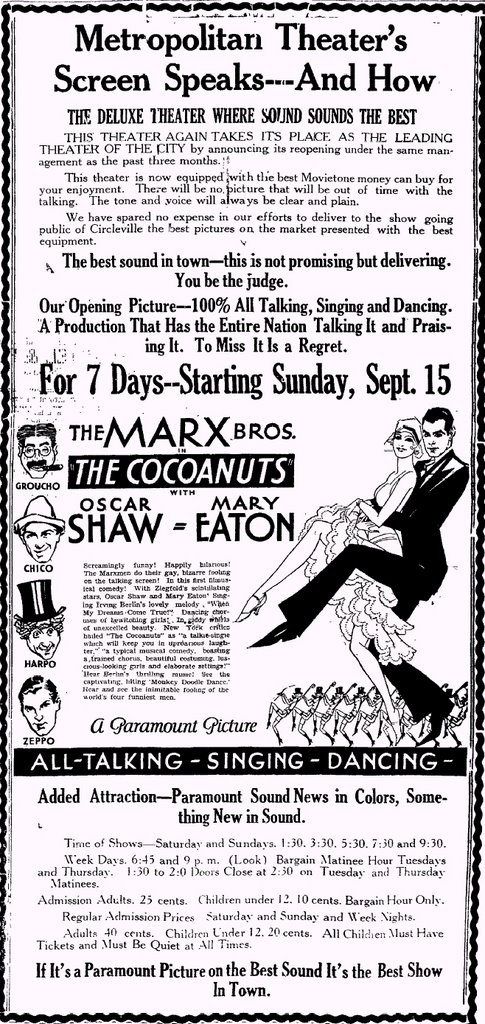
Paramount's "The Cocoanuts" was selected as the grand re-opening feature for the Metropolitan Theater in Circleville, Ohio --- a theater which clearly had some issues with disc based sound reproduction systems, as revealed in the delightful ad to the left. Although Irving Berlin's "When My Dreams Come True" was to emerge as the hit from the filmed version of the 1926 stage musical, it's ultimately dreary when compared to "The Monkey Doodle-Doo," which --- oddly, wasn't widely recorded at all.

A lush version of "When My Dreams Come True" that hails from Australia, featuring a female vocalist who does as well or better than Mary Eaton.

"When My Dreams Come True" (1929) - Australia

As hot a tune as Paul Whiteman's band ever approached, "The Monkey Doodle-Doo" was recorded under the house-band alias "Busse's Buzzards" for Columbia in the last days of 1925. To quote the movie ad, "to miss it is a regret."

"The Monkey Doodle Doo" (1925)


Metro-Goldwyn-Mayer spared no expense advertising and promoting "The Broadway Melody," a landmark film which well deserved whatever boasting rights the studio could muster up. Theaters that booked the film had access to a wide array of ad copy, including one clever bit of advertising showmanship in the form of what looked to be an honest to goodness Western Union telegram from MGM to the theater owner, granting them --- above all other theaters in the area --- the right to show the film based upon their individual sterling qualities as presenters of fine motion pictures. Although this gimmick probably fooled as many newspaper readers as it was supposed to, audiences would arrive in droves with or without it.
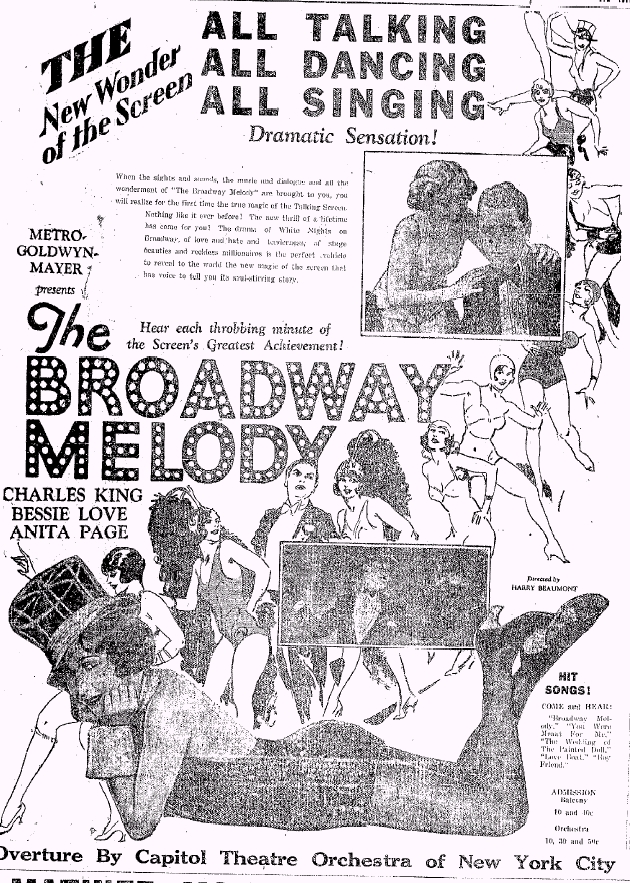
It's interesting to note in the ad at left that even the smallest of local theaters presented the film with a specially recorded Overture (by New York's Capitol Theater Orchestra), discs of which seem to have fallen by the wayside.

Commercial recordings of the film's tunes are as many and varied as they are familiar, so here's two lesser known renditions of the title tune.

The first, by incredibly prolific songster Irving Kaufman (was there a record label he didn't record for?) is surprisingly restrained for a vocalist with a voice that could rival a klaxon and burst from the grooves of even the cheapest of dime-store discs.


Odd though the combination is, Hawaiian guitars don't seem especially out of place in the second version, by a group calling themselves "The Four Aces," on the bargain Velvet-Tone label.
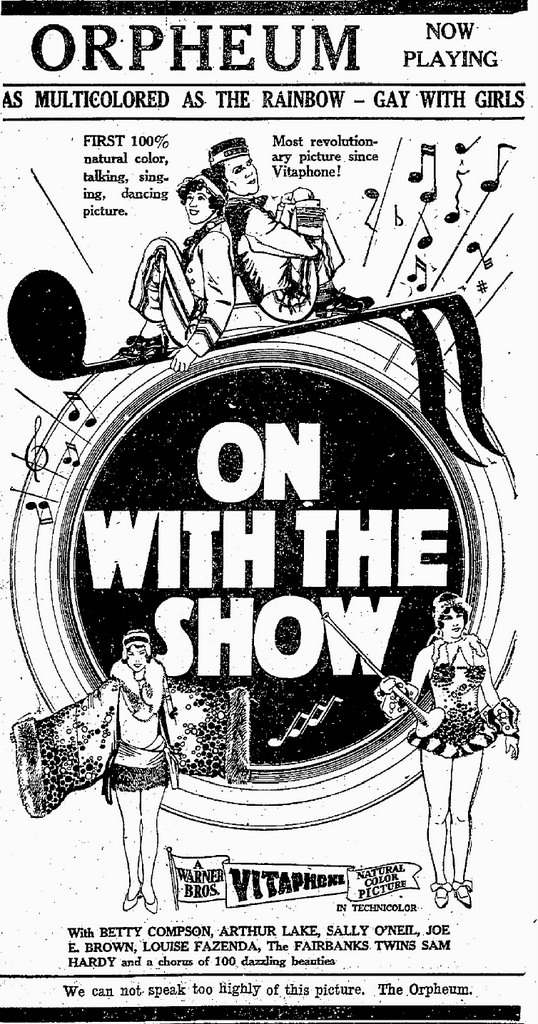
Little more than a scant minute or so in length, a fragment of recently discovered Technicolor footage will eventually allow us a glimpse --- for the first time in over seventy-five years --- of what so captivated audiences and critics alike when the Warner Bros. all-Technicolor production "On With the Show!" first premiered.

The prognosis is somewhat more optimistic for Warners' other smash-hit all-Technicolor release of 1929, "The Gold Diggers of Broadway," a film that seems intent upon slowly putting itself back together after decades of assisted exile from the world of the living.
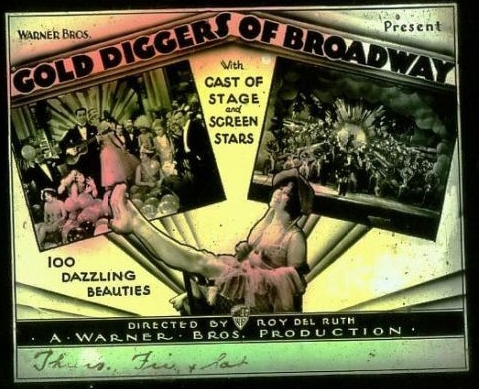
British dance orchestras seem to have had a remarkable knack for producing the best 78rpm medleys from early musicals, and what follows are three of the best.

The first is a selection of tunes from "On With the Show" recorded by the Broadcast Dance Orchestra in late 1929. Included: "Welcome Home," "Am I Blue?," "Birmingham Bertha," "Let Me Have My Dreams," and the unfortunate "Lift A Julep To Your Two Lips.

From "Gold Diggers of Broadway," a two-sided medley (joined into one file here) quite unique in that it covers just about every tune performed in the film (aside from incidental scoring), three of which were never commercially recorded in the United States to my knowledge. Although the sonic quality is a bit thin, it's a remarkable compilation of diverse melody and rhythm. Included is: "In a Kitchenette," "What Will I Do Without You?," "The Gold Digger's Song," "Tip Toe thru the Tulips," "Go To Bed," "Keeping the Wolf from the Door," "Painting the Clouds With Sunshine," and "Mechanical Man."

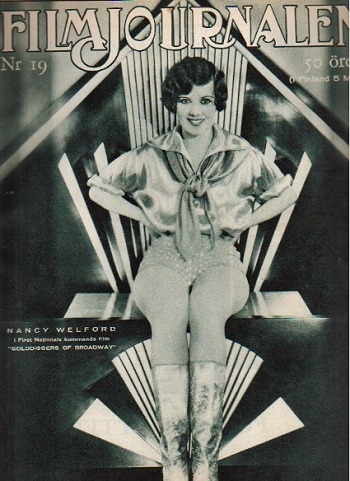
From Al Jolson's 1930 part-Technicolor film "Mammy," which has made a few furtive appearances on screens following its recent restoration before retiring to points unknown, our last British dance band medley --- this time featuring tunes by Irving Berlin.

To give fair due to elaborate recorded medleys from early musicals that were produced on these shores --- and there weren't that many --- a fine one by Ben Selvin and His Orchestra paying homage to Metro's "Hollywood Revue" recorded for Columbia in late August of 1929.
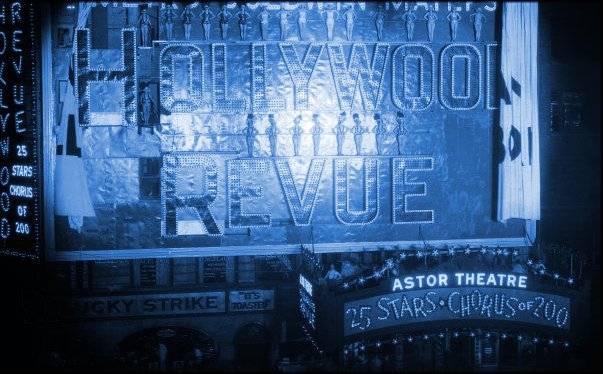
Included: "Your Mother and Mine," "Orange Blossom Time," "Nobody But You," "Singin' in the Rain," and "Low Down Rhythm."


Medley - "The Hollywood Revue" (1929)


Lastly, in response to a reader's request regarding the previous post (Melody Native), although Ramon Novarro did not record a commercial version of "The Pagan Love Song" at the time the film was in release, he did include it in a medley of tunes recorded in Great Britain in 1936. Despite the fact that Novarro's accent seems to have thickened considerably since 1929, whether in actuality or not, it's a lovely recording --- although there's an underlying strain of sadness that's as touching as it is difficult to quite define.


Medley - Ramon Novarro (UK-1936)


###

13 November 2006

Melody Native

When the early talkies weren't busily exploring the backstage area of theaters and night clubs --- which wasn't often, they displayed a remarkable diversity of settings that belies the popular and largely incorrect notion that they were all hopelessly static, claustrophobic productions. If anything, it's the films that would arrive in 1931 and 1932 that seem to me to always be set primarily in offices and apartments, --- or at least the vast majority of them do.

Audiences between 1929 and 1930 who desired something other than views of dancing legs, dressing rooms and city streets enjoyed a wealth of options. Those seeking far flung exotic locales could see films set in jungles, tropic isles, the Far East, atop the ocean and underneath it, and amidst polar glaciers. Equally exotic but no less picturesque were films entirely or partially set in prisons, airplanes, zeppelins, submarines, ships of the sail and steam eras, rail and subway trains, coal mines, the deep woods, snowy mountain ranges and just about every European city you can think of, ancient and modern.

The one setting that most easily lent itself to melody (although no setting or locale was beyond the ingenuity of film theme song composers) was the tropics. Irresistible to composers and lyricists, even what is thought to be the first modern era stage musical, "Florodora" (1900-1902) had a mythic tropical setting that allowed for at least two songs which celebrated that fact --- and countless tropical themed melodies would follow in the coming years, most rather undistinguished and sounding suspiciously much alike, but vastly popular nonetheless.

"The Pagan," an MGM feature released in April of 1929, hit the mark with escapist minded audiences and devout fans of its star, Ramon Novarro, alike. Although a silent film with a synchronized music, vocal and sound effects score, "The Pagan" had enough drawing power to succeed at a time when theaters were swelling with all-talkie product. Visually stunning, and containing what many justly believe to be Novarro's signature performance and perhaps even role of a lifetime, success of "The Pagan" was also due in no small way to the film's theme song, which swept the country and globe before, during and after the film's release. Despite the widespread popularity, it's always interesting to find one somewhat slightly dissenting voice, as it was with one unnamed reviewer in a July of 1929 newspaper:

"Novarro, who is said to be studying for the opera, sings the theme song --- and you are never in doubt deciding it to be the theme song. It is sung again and again, at opportune times and some not so opportune. This song is the only vocalization...."

While not the "only vocalization" in the film, "The Pagan Love Song" may arguably seem that it is. That aside, its first presentation in the film is incredibly memorable, with Novarro first hearing the melody as a siren song --- from a distance, wafting across water, seashore and greenery. Intrigued, he follows it --- slowly, then rushing forward through the underbrush, while "answering" it with his own vocalization of the tune until he reaches the source, thereby kicking off the film's plot-line. Far better seen and heard than described, the effect is dramatically lessened by an error in circulating prints that ruins the once careful synchronization, rendering the sequence more than a bit confusing and unintentionally clumsy. A few moments of a well placed someones time is all that's needed to fix the problem, but --- ah well, so it goes.


One of the purest and most faithful to the source period interpretations of the tune can be heard here by vocalist Annette Hanshaw. Epic in its simplicity.

"The Pagan Love Song" (1929)

1929 would also find Joan Crawford removed from a dance floor and placed in a jungle in "Untamed," but unlike "The Pagan," her character (given the chimp-ish name "Bingo" here) lost no time in hitching a ride back to civilization and, well --- dance floors. The film spawned two popular melodies, "That Wonderful Something" (which can be heard in numerous other 1929 and 1930 Metro films as background music) and the far more memorable, in my opinion, "Chant of the Jungle."


Here, two fine 1929 versions of "Chant of the Jungle" recorded just weeks apart. The first a strident, somewhat sensual rendition by Paul Specht and His Orchestra for the Columbia label, and the second a more playful, high spirited interpretation by Nat Shikret and the Victor Orchestra.

"Chant of the Jungle" (1929) Paul Specht & His Orchestra


"Chant of the Jungle" (1929) Nat Shilkret & His Orchestra


The only palm tree to be seen in Warner Bros. "Is Everybody Happy?" (1929) was one serving as a backdrop for a wonderfully tawdry song and dance number by Ann Pennington, the chirpy and risque tune "Samoa," which can be heard (although not seen --- the film is lost) in an early sequence where fresh from Budapest to New York City immigrant and saxophonist Ted Lewis happens upon his leggy girlfriend from the old country after spotting a poster outside a "follies" theater.


"Once they sail into the bay, then they never sail away,
from old Samoa --- Hello, Aloha!

It's the port of missing men, 'cause they won't come home again,
from old Samoa!

They say the native girls wear dresses there with leaves that are grown,
I've never seen a sailor yet who'll leave them alone ---

Once I heard a captain crack, as they danced around his shack,
'I want some more of some more of Samoa!'"


Simply because we have the rare luxury of being able to do so, here's the "Samoa" sequence from both the domestic release version of the film, and the foreign export version. The latter version gives fair indication of how these overseas release versions were prepared, with music and song being brought up front and center and dialogue being deleted altogether or bridged over with a newly prepared musical score. (The domestic release segment contains what's probably the most intentionally amusing dialogue exchange in the whole film. Listen for it!)

"Samoa" (1929) Domestic Release Version


"Samoa" (1929) Foreign Release Version


Lastly, although firmly out of the early talkie era, and for no reason other than I think you may enjoy it, a few moments of the Hawaiian themed melody, "Honolulu Baby," from the 1933 Metro-Roach film "Sons of the Desert," which --- for the uninitiated --- starred Stan Laurel and Oliver Hardy.


Not a soundtrack excerpt nor a commercial 78rpm recording (it was never recorded for that purpose, inexplicably) the following audio is that of a scoring session disc recorded prior to actual filming and then played back whilst the cameras rolled. For those familiar with the film, it's always a novelty to hear the melody without a dialogue overlay and other ambient effects. Roach Studio composer/musician Marvin Hatley supplies the tune, and Ty Parvis the vocal.


"Honolulu Baby" (1934)

Aloha!

###