Showing posts with label Publicity. Show all posts

12 November 2006

An Audience Mystified


Not long after the birth of recorded sound itself, the same instrument that astonished the world would take on a far more mundane and familiar chore, that of first advertising itself --- and then every other technical innovation it would spawn.

In the following justly famous Edison advertising cylinder from 1906, the phonograph is brilliantly presented not merely as just a way to hear selections from "The Bohemian Girl" after a theatrical presentation has left town, but as an indispensable mechanical device bestowed with almost human qualities, always at the ready to serve you.

"Edison Advertising Cylinder" (1906)


If your home contained dispirited elders, the phonograph was there to draw them from the chimney corner and effectively amuse and quiet them --- while serving a similar purpose for dull infants, raffish youngsters, a fatigued spouse, or those confined to the sick room who always ran the risk of becoming potential candidates for transforming into one of the "loved ones who are far away" mentioned in the machine's recording capability segment.

While unspoken, the selling point here is clearly that of a product that will effectively relieve the owner from restrictive domestic duties, leaving them free to presumably rush out and buy additional cylinders to keep the phonograph fed and running. Or, perhaps to visit... Coney Island?


Although it would take time, recorded sound and Edison's phonograph would cease being a novelty. Instead it became so completely integrated into the movement of daily life that a visitor to Coney Island's Luna Park probably wouldn't be astonished by the raucous sound of a mechanically reproduced voice saying "Thank You" from a concealed speaker as they exited an attraction via a gate or turnstile. While I suppose a typical reaction might be along the "What won't they think of next!" sort, the real purpose of the installation was to create memorable and effective cross promotion for a product or service other than the one just consumed.

In the brief audio fragment offered below, patrons were lured to ride adjacent attractions such as "The Pretzel Ride," "The Wild Cat," Scooters, "The Whip" (for real fun!), "The Old Mill" or merely politely asked to try (meaning buy) popcorn.


The effectiveness of the device isn't known, but I suspect it wouldn't be long before the small cylinders became horribly degraded from constant use, ultimately emitting a garbled squawk that would frighten or annoy rather than persuade. Then too, pity any attendant stationed nearby for hours on end!

The arrival and wide public acceptance of radio as a source of immediately accessible entertainment coincided with the arrival of talking films, and both mediums formed an almost instant union with the objective of one aiding the other, although ultimately it was film that reaped the benefit.


In a convoluted bit of supreme joint effort, the following audio excerpt from 1929 features a radio show ("Brunswick Brevities") that was transcribed onto phonograph discs, promoting radio sets for the home by utilizing a medley of tunes from a selection of then current talking pictures produced by MGM. Everyone was served --- and then some, while the public enjoyed a lovely piece of music to listen to over dinner. Here, a Brunswick Brevities "talkie medley" containing tunes from "The Pagan," "The Broadway Melody," "Marianne" and "The Hollywood Revue."

"Brunswick Brevities" (1929) - Excerpt


The early musicals were a boon to the record and sheet music industries, with all closely aligned corporate hands in a pot being duly filled with coin at every turn, as the public sought to quench its thirst for music from the latest talkies they've seen, or wanted to see --- or somehow managed to miss.

Here, in a promotional disc produced by the Victor Record Company, Richard Barthelmess' film "Weary River" (First National-1929) is used as the peg upon which to hang lures for not one but two different renditions of the film's theme song (by Rudy Vallee and Gene Austin) and also for the film itself.


Victor Promotional Disc for "Weary River" (1929)

Not long afterward, Columbia could be heard promoting its Tele-Focal radio ("No dead spots on the dial!") via a transcribed radio commercial elegantly masquerading as an entertainment offering, that utilized Ben Selvin & Ruth Etting's recording (on the Columbia label) of "Dancing With Tears In My Eyes" (a fantastically popular tune unwisely cut from the 1930 Warners film "Dancing Sweeties") as the primary lure.


In then new concept that would outlive products, songs, films and activities --- and generations of consumers, for that matter, it's still with us today but as an inescapable bludgeon rather than something as genuinely attractive as the closing offering, a transcribed radio promotion for the 1933 Paramount film "Torch Singer," wherein it is supposed Claudette Colbert's singing voice was supplemented with one belonging to vocalist Sylvia Froos. As with most things, the illusion is preferable to the reality. Certainly more mystifying.

###

26 October 2006

The Curse of the Mean Cicero Blues

The Duncan Sisters, Vivian & Rosetta, 1929


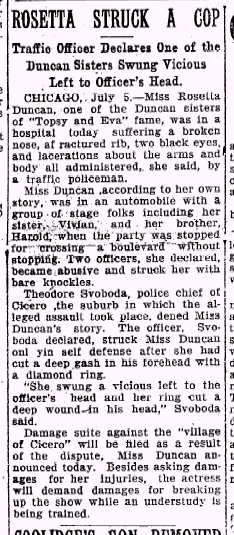
The news items that appeared in papers around the world in July of 1924 read like something that could have, and very well may have, caught your eye over yesterday's breakfast: "Noted Celebrity in Slug Fest!," "Struck a Cop!" "Swung Vicious Left to Officer's Head!"

The celebrity involved here was Rosetta Duncan, half of a once wildly popular sister act, The Duncan Sisters... Rosetta and Vivian. Singers, dancers, comedians, musicians. Do it all and do it well actresses. Performers since childhood, stars of vaudeville, Broadway stage and motion pictures (both silent and sound), prolific recording artists spanning the acoustic, electric and LP eras. They'd entertain home front audiences during the first World War, and would still have name power enough to perform for troops during World War II. And, in the waning years of their mammoth career, they'd also appear on television, and even play Las Vegas. In other words, they had the sort of long lived and all encompassing career that most performers can only dream of.

You don't last that long without hitting a few bumps in the road, and the Duncans were no exceptions. Marriages, both successful and not, highly publicized divorce trials, spats, litigation, hospital stays, auto accidents, and all the usual events that come to most of us without being detailed in news journals. But, for all this, the Duncans always seemed to take it on the chin and bounce back, none the worse for the wear. Although their basic performing style never seemed to change (they continued to interpolate their successful "Topsy & Eva" child characters into all their performances long after it could be carried off convincingly), they appeared to escape criticism because they were always in on the joke and never pretended to offer or be anything else than what they were --- take it or leave it.

Now, let's get back to 1924. You can read all the details in the article to the right from the Lincoln Night Journal of July 5th, but in a nutshell: With Rosetta at the wheel of a car who's contents included her sister Vivian, her brother Harold, and others, they dashed across an intersection in the Chicago suburb of Cicero --- and were stopped by a traffic cop. At this point, what happened next is speculative. 4'11", 104lb Rosetta claimed she was verbally and physically abused by the policeman, who landed a blow to her face. The cop, a strapping 6'2, 225 bloke, in turn, claims it was she who struck him --- gashing his head in the process.

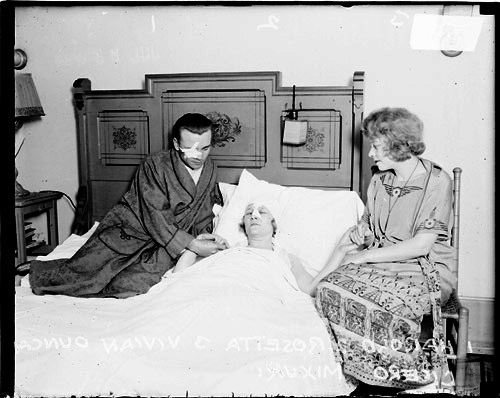
Then as now, there's no such thing as bad publicity, and the Duncans lost no time in inviting photographers from the Chicago Daily News to visit them while Rosetta convalesced. In the photo below, we see brother Harold Duncan (a shadowy figure in their life whom I could find little about) who also seems to have experienced injuries that went unreported in any news account I've read, Rosetta Duncan --- sporting a standard issue concussion bandage along with a bit of plaster tape to the nose, and the entirely unscathed Vivian Duncan.

The case would drag on, with each party embellishing and elaborating until the policeman faced an attempter murder charge --- while, in the interim, the initial traffic violation was dismissed with Rosetta paying a fine of $1 (plus costs) on or around July 16th of 1924.

Here, details as to the ultimate outcome are difficult to ascertain --- but the lack of any further news reports suggests the entire matter was dropped and forgotten.

Or was it?

In a highly contemporary move that would be admired today, the entire debacle was set to music and lyric, with the result being "The (Mean) Cicero Blues," published in November of 1924 and then preserved forever on shellac by the Duncans for Victor Records that same month and year.

Included in their performing repertoire while the song's newsworthy value remained, "Mean Cicero Blues" exists today as what can be considered a surprisingly forward-thinking example of celebrity exploitation --- turning an unfortunate and rather mundane incident on a quiet street in the Cicero neighborhood of Chicago, into a revenue earning non-sensation.

"Mean Cicero Blues" (1924)

Years pass --- and with them, the news story and song fade into nothingness. By the late 1950's, the Duncans performed sporadically together, but Rosetta plugged on --- the born show-biz trouper personified. Occasionally, a special play date would prompt Vivian to join the act again, as she would do in early December of 1959 at a Chicago night club that featured a nostalgia-themed floor show. The 1920's had become just distant enough as to become nostalgic, and the Duncans were there as living reminders of an earlier day and form of entertainment.

After one of these performances, as Rosetta was driving to a friend's home, she lost control of her car and it crashed into a bridge post --- with Rosetta suffering fatal injuries and dying soon thereafter without ever regaining consciousness.

Although the incident of 1924 was, by every indication, forgotten by the news services, surely Vivian Duncan couldn't help but notice the irony of that her sister's fatal car accident happened to take place in the still quiet suburb of Chicago known as Cicero.

Chicago Daily News Photo #DN-0077122, Courtesy of the Chicago Historical Society

###

Addendum:

My personal favorite of all the Duncan Sisters' many recordings, "The Argentine, the Portuguese and the Greek," recorded in the U.K. for HMV in 1928. You may find the subject matter odd, or inflammatory... or both, but stick with it until the end and you just may well be as surprised as most listeners are upon hearing it for the first time:

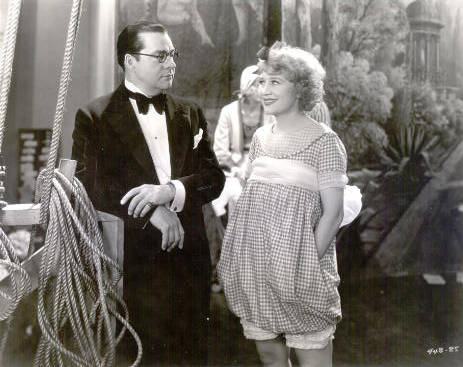
Left: Jed Prouty and Rosetta Duncan in a scene from "It's A Great Life," (MGM-1929)


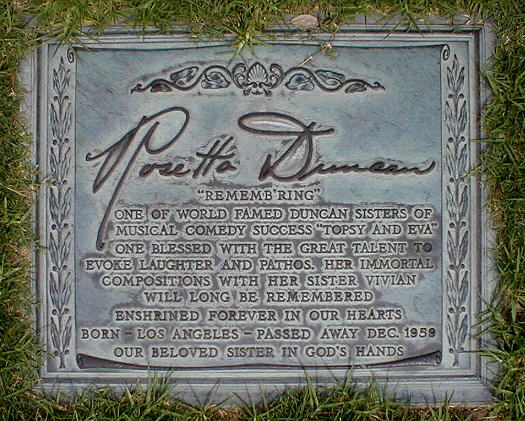
Right: Rosetta Duncan's grave marker, Forest Lawn Memorial Park, Los Angeles, California

25 October 2006

Hearts Forever Plighted

For all the controversy, real and imagined, forever embedded within D.W. Griffith's magnificent "The Birth of a Nation," there can be found one element that defies criticism and time itself --- that being a musical piece composed and compiled for the film by Joseph Carl Breil.

Titled "The Perfect Song," further defined as a "love strain," and serving as what would eventually become to be known as a theme song, it's an incredibly lovely composition that, when disconnected from the context of the film, stands up remarkably well as a melody of no particular time nor place --- but still unmistakably stirring and evocative.

How beautifully right, then... or wrong, depending upon how you look at it, that the same melody that accompanied one of the earliest motion picture blockbusters should come to be used --- some fourteen years after it's introduction in 1915, as the theme for the "Amos 'n Andy" radio show, itself a blockbuster and landmark in broadcasting history.

Initially heard as a languid organ solo that bookended the transcribed portion of the show --- and often performed live by a radio station house musician, the melody soon caught the public's fancy, many of whom surely recalled the tune's origin. But, by 1929, Griffith's film was a distant relic of another day --- and the melody would soon become inseparable from the brilliant comedic character creations of Freeman Gosden and Charles Correll.

Here, to our left, is Gosden and Correll autographing copies of a slim book entitled "All About Amos 'n Andy" for delighted fans in a Chicago department store, in 1929 --- just as their radio show and their popularity were exploding across the country.

In an example of cross-promotion of the sort we usually prefer to believe is a relatively modern concept, one could, in 1930, listen to the radio show, buy at least two published books, see the performers in the RKO film "Check and Double Check," read a daily comic strip syndicated to newspapers nationwide and then, at the end of the day, dance to the show's theme song --- "A Perfect Song," now far, far removed from it's original but no less dramatic source.

Here then, is a 78rpm recording of "The Perfect Song," as performed by the Hotel Pennsylvania Orchestra, with vocals, recorded on January 15th of 1930, and issued on the Velvet-Tone label.

The Perfect Song (1930)


Freeman & Gosden image courtesy of the Chicago Historical Society,Chicago Daily News negatives collection, DN-0087461.

###