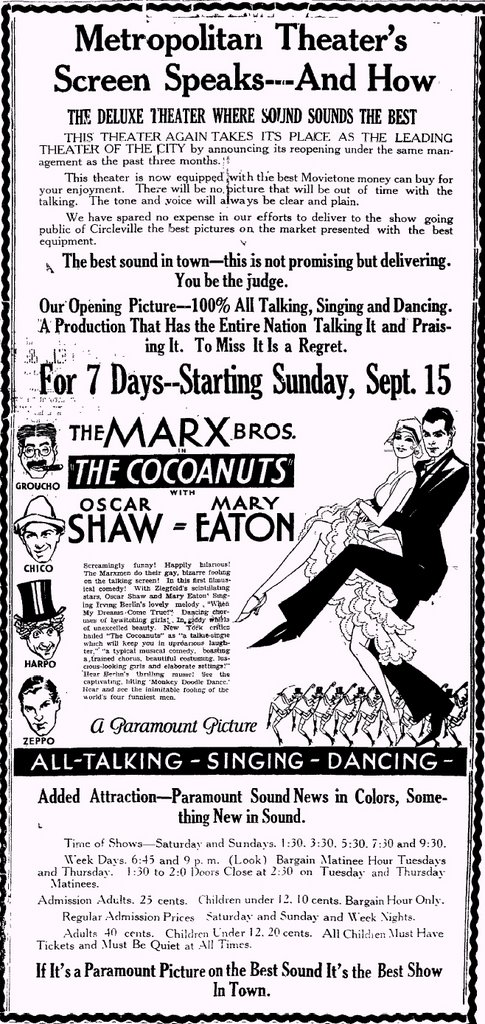
 Paramount's "The Cocoanuts" was selected as the grand re-opening feature for the Metropolitan Theater in Circleville, Ohio --- a theater which clearly had some issues with disc based sound reproduction systems, as revealed in the delightful ad to the left. Although Irving Berlin's "When My Dreams Come True" was to emerge as the hit from the filmed version of the 1926 stage musical, it's ultimately dreary when compared to "The Monkey Doodle-Doo," which --- oddly, wasn't widely recorded at all.
A lush version of "When My Dreams Come True" that hails from Australia, featuring a female vocalist who does as well or better than Mary Eaton.
"When My Dreams Come True" (1929) - Australia
As hot a tune as Paul Whiteman's band ever approached, "The Monkey Doodle-Doo" was recorded under the house-band alias "Busse's Buzzards" for Columbia in the last days of 1925. To quote the movie ad, "to miss it is a regret."
"The Monkey Doodle Doo" (1925)
Metro-Goldwyn-Mayer spared no expense advertising and promoting "The Broadway Melody," a landmark film which well deserved whatever boasting rights the studio could muster up. Theaters that booked the film had access to a wide array of ad copy, including one clever bit of advertising showmanship in the form of what looked to be an honest to goodness Western Union telegram from MGM to the theater owner, granting them --- above all other theaters in the area --- the right to show the film based upon their individual sterling qualities as presenters of fine motion pictures. Although this gimmick probably fooled as many newspaper readers as it was supposed to, audiences would arrive in droves with or without it.
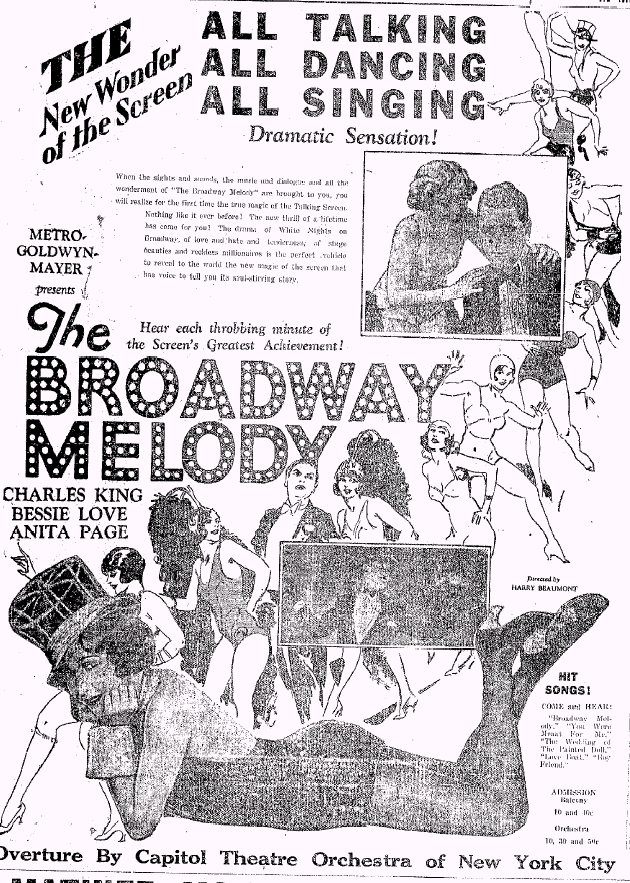 It's interesting to note in the ad at left that even the smallest of local theaters presented the film with a specially recorded Overture (by New York's Capitol Theater Orchestra), discs of which seem to have fallen by the wayside.
Commercial recordings of the film's tunes are as many and varied as they are familiar, so here's two lesser known renditions of the title tune.
The first, by incredibly prolific songster Irving Kaufman (was there a record label he didn't record for?) is surprisingly restrained for a vocalist with a voice that could rival a klaxon and burst from the grooves of even the cheapest of dime-store discs.
Odd though the combination is, Hawaiian guitars don't seem especially out of place in the second version, by a group calling themselves "The Four Aces," on the bargain Velvet-Tone label.
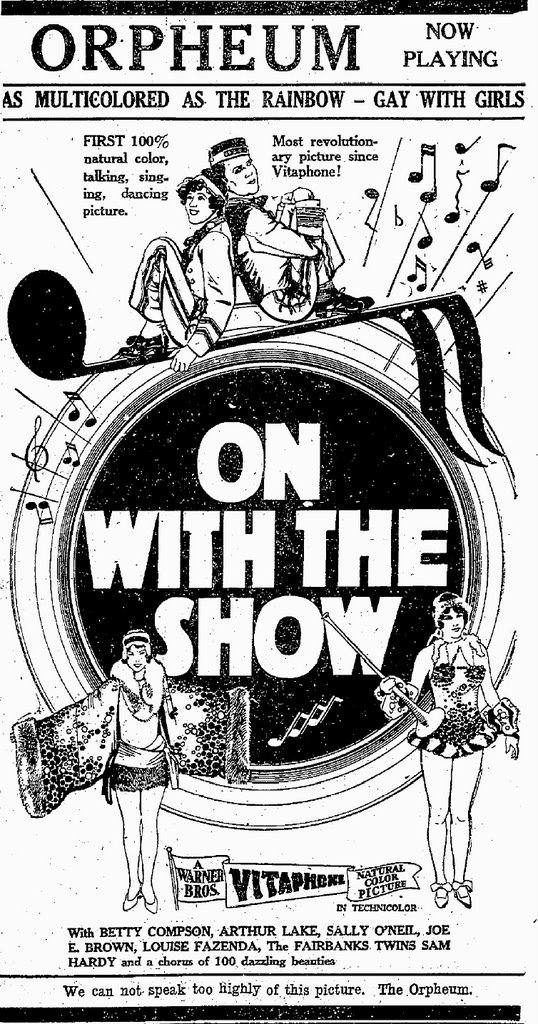 Little more than a scant minute or so in length, a fragment of recently discovered Technicolor footage will eventually allow us a glimpse --- for the first time in over seventy-five years --- of what so captivated audiences and critics alike when the Warner Bros. all-Technicolor production "On With the Show!" first premiered.
The prognosis is somewhat more optimistic for Warners' other smash-hit all-Technicolor release of 1929, "The Gold Diggers of Broadway," a film that seems intent upon slowly putting itself back together after decades of assisted exile from the world of the living.
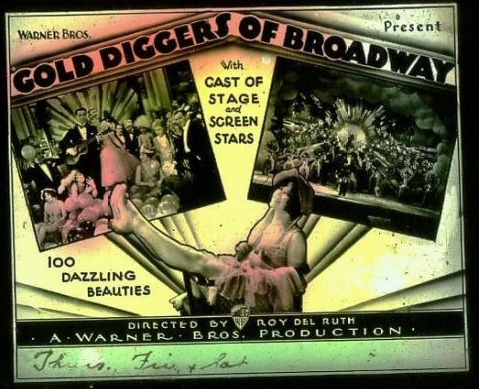 British dance orchestras seem to have had a remarkable knack for producing the best 78rpm medleys from early musicals, and what follows are three of the best.
The first is a selection of tunes from "On With the Show" recorded by the Broadcast Dance Orchestra in late 1929. Included: "Welcome Home," "Am I Blue?," "Birmingham Bertha," "Let Me Have My Dreams," and the unfortunate "Lift A Julep To Your Two Lips.
From "Gold Diggers of Broadway," a two-sided medley (joined into one file here) quite unique in that it covers just about every tune performed in the film (aside from incidental scoring), three of which were never commercially recorded in the United States to my knowledge. Although the sonic quality is a bit thin, it's a remarkable compilation of diverse melody and rhythm. Included is: "In a Kitchenette," "What Will I Do Without You?," "The Gold Digger's Song," "Tip Toe thru the Tulips," "Go To Bed," "Keeping the Wolf from the Door," "Painting the Clouds With Sunshine," and "Mechanical Man."

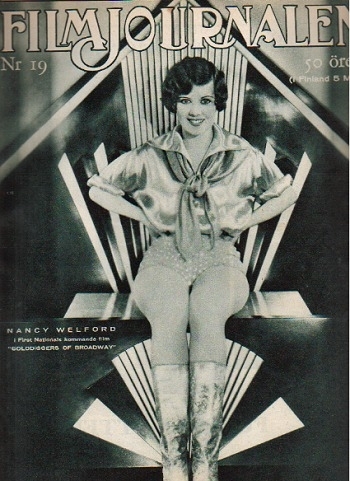 From Al Jolson's 1930 part-Technicolor film "Mammy," which has made a few furtive appearances on screens following its recent restoration before retiring to points unknown, our last British dance band medley --- this time featuring tunes by Irving Berlin.
To give fair due to elaborate recorded medleys from early musicals that were produced on these shores --- and there weren't that many --- a fine one by Ben Selvin and His Orchestra paying homage to Metro's "Hollywood Revue" recorded for Columbia in late August of 1929.
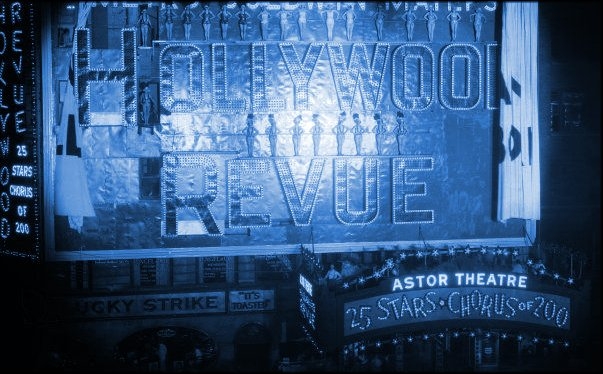 Included: "Your Mother and Mine," "Orange Blossom Time," "Nobody But You," "Singin' in the Rain," and "Low Down Rhythm."
Medley - "The Hollywood Revue" (1929)
Lastly, in response to a reader's request regarding the previous post (Melody Native), although Ramon Novarro did not record a commercial version of "The Pagan Love Song" at the time the film was in release, he did include it in a medley of tunes recorded in Great Britain in 1936. Despite the fact that Novarro's accent seems to have thickened considerably since 1929, whether in actuality or not, it's a lovely recording --- although there's an underlying strain of sadness that's as touching as it is difficult to quite define.
Medley - Ramon Novarro (UK-1936)
###